Compound Wall Mural

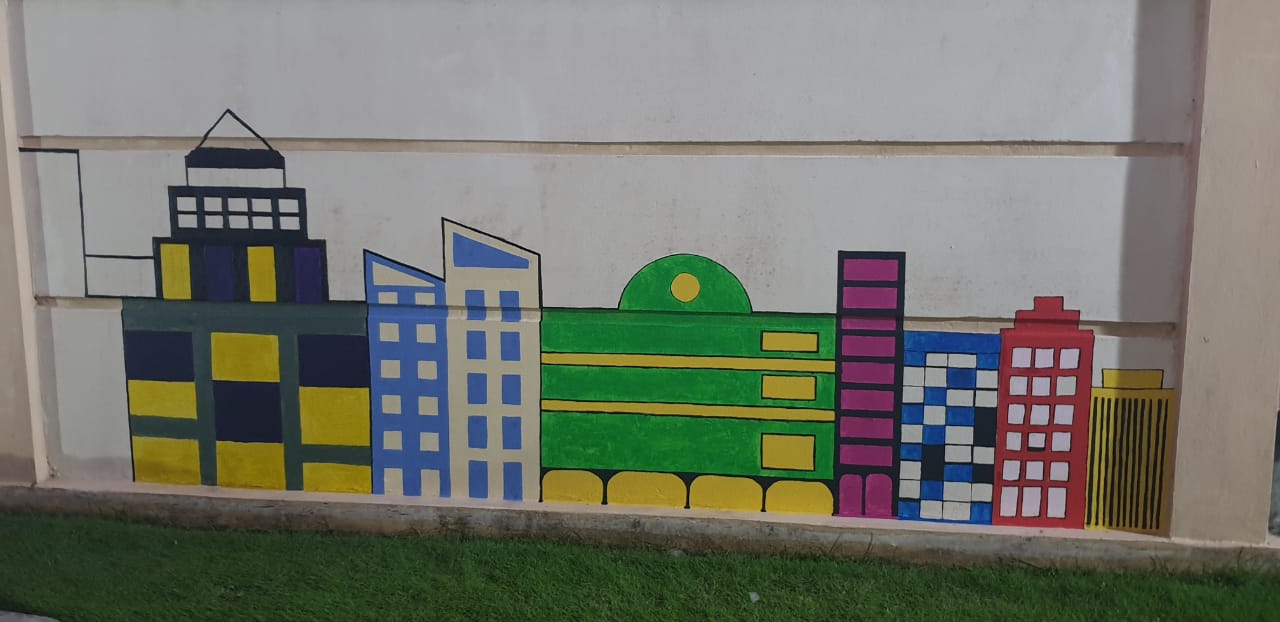
House compound wall doesn’t have to be boring. What better ways to wind down from a stressful day at work than to go home, sit back and relax in your garden chair, sipping a cup of tea, while enjoying the colourful murals adorning your house compound wall. It is surely a sight that we seldom see here in Brunei. Thus, when a relative asked me if I would like to do some artwork on one of the panels of their house compound wall, I couldn’t say yes fast enough and I knew exactly right away what I was going to create.

Day 1: Yellow office building, Red hotel, Blue apartment building

Post mortem of day 1: Brunei is a hot hot country. Despite erecting a tent to block the sun, I could still feel the heat and was all sweaty. My glasses kept on sliding down my nose due to the sweat. So day 2 I started painting at 4.30pm just to get the sun out of the way. A long power extension cable came in handy to power a fan to keep cool. 

Day 2: Added Pink condominium, Green convention centre, Blue and Cream apartment buildings

Post mortem of day 2: Starting off late obviously left me just a small window of sunlight. I tried to push through into the evening with lighting from 2 spotlights but the visibility was just not the same.  

Day 3: Added a Shopping Mall and outline of the adjoining Apartment Complex

Post mortem of day 3: It had rained the night before, and I arrived to see some blotches on some of the completed buildings. I spent some time fixing them and with the limited daylight I got, I only managed to partially complete one additional building.   

Day 4: Completed the front buildings and added back buildings

Post mortem of day 4: Now that the meticulous part was done, doing the back buildings was quite easy and quick. The all black colour made the front buildings pop. My Gotham city was starting to take shape. 

Day 5: Added some dramatic effects – a news chopper, a blimp, a bat signal and background rays

Day 6: Last day. Some final touches and the masterpiece was done. It was a pleasure to have the opportunity to do this project. It took me 30 minutes just standing there admiring it, hand on my chest, before I left. Off to the next project! Cue the batman theme song….

Its All in the Narratives

So, by now we have established that the Covid-19 threat seemingly was not handled strategically here. Despite “infectious diseases” for quite some time now being recognised as one of the transnational threats discussed in many national, regional and international gatherings; despite the experience from the swine flu outbreak that hit the nation in 2009-2010; despite the many strategic planning documents launched; despite the repeated sentiments on the whole-of-government, whole-of-nation approach, alas we are still running around like headless chicken. We know and heard as early as October last year how terrifying the Delta variant is, but yet we let our guard down big big time. The image of the perayaan crowd, people of all ages rubbing shoulders, no mask, kept on creeping back to mind. This was perhaps the time when the virus made its rounds that when the first case of the second wave was detected on 06 August 2021, the virus already had a big headstart. 

Unlike during the first wave back in early 2020, this time around there are vaccinated people meaning these people won’t be “immobilised” by sickness if they got the virus, continuing their normal daily activities not knowing that they are positive with Covid-19 spreading the virus to anyone they are in contact with. By the time the second wave was uncovered on 06 August 2021, there could already be thousands of “positives” throughout the country. At this stage, contact tracing is futile and a lost cause. The daily reporting of new cases, new clusters, number of people recovered, etc on those fancy slides during the daily press conference does not serve any strategic value in handling this crisis. Worst of all, blaming the public instead for being “babal” for the failure to contain the spread to me came across as irresponsible. On one shocking occasion, when asked about why there are still transmissions despite the SOP in place, the response was because of “takdir” (fate). And this was during a formal press conference. WOW.

Our population is small. There are no staunch anti-vaxxers, anti-maskers, anti-SOP Karens and Kevins here to deal with. Those people who inadvertently enabled the virus to spread by not social distancing, by conducting social gatherings, by going biking in a group, and other activities of the sorts, they didn’t deliberately do it just to be babal, they are just following their instincts and assumptions. And these instincts and assumptions are shaped by the narratives on the Covid-19 issue. At the press conference, the lead in his suit, sitting down, once seen wearing a face mask with a cartoon cat on it, reading out a prepared text, using fancy colourful slides with cute  icons, responding to questions with answers on the fly, occasionally including some jokes in them followed by laughters from the reporters. These jokes came minutes after announcing the deaths from Covid-19. Now, do we blame those people labelled as “babal” for not taking the covid threat seriously??  

Just saying….  

Twist of Fate

One morning in July 1991, Zai was pacing up and down the living room, peering through the window every 5 minutes. She was anxious. After a hard discussion with her husband, she finally agreed to employ a domestic helper to take care of their 2¼ years old child. Zai had been burned out for the past year juggling between house work and taking care of their toddler. Her husband thought a domestic helper will provide Zai the much needed breathing space. The day had finally come as Zai anxiously waiting for the maid to be delivered to her house. 

A little bit after 9am, a white Toyota Corolla pulled in her driveway. It was Zai’s friend Jauyah. Jauyah played a big part in Zai’s decision to agree with getting a domestic helper. She had been coaxing Zai about how beneficial it would be for Zai to get a maid and assuring her that it was hassle free and she would deliver the maid in no time. And deliver the maid in no time she did. What Zai didn’t know at that time was that “the maid” is the cousin of Jauyah’s maid. This cousin had already arrived in Brunei and living in Jauyah’s house in Telisai eager to follow her cousin’s footstep to earn money to be sent to her poor family in the Philippines. Jauyah had been contacting several people, Zai included, persuading them to get a domestic helper and she could help in getting and delivering one. 

Out the car with Jauyah was the domestic helper, wearing worn out shirt and skirt, flip flops, a worn out duffle bag on her shoulder. It was not hard to tell that this woman had a tough life. As they reached the door, Jauyah introduced them, “Shirley, this is Zai. You will be working with her from now on”. With her head down, Shirley said “Good Morning maam”. Zai pointed to the room by the kitchen and said “you can put your bag in there”. Shirley nodded her head, smiled and said “Thank you maam”, but just stood there. Then Jauyah said “Oh by the way, Shirley doesn’t speak any Malay or English”. It turned out that Good Morning and Thank You are the only English words that she knew. But Jauyah assured Zai that Shirley will learn the language “in no time”. Apart from Shirley being 30 years old, had experience working in a dressmaking shop and nannying a child  back in the Philippines, and oh yeah speaks no English or Malay, Jauyah didn’t offer much more information on this maid to Zai. Still speechless with the revelation about the language barrier, with the dumbfounded look on her face, Zai watched Jauyah got in her car and left. It was too late for her to change her mind now…

How to train someone who doesn’t speak your language? There was no goggle translate back in the 1990s. But Zai just had to suck it up and put in the effort. Despite her best efforts and a lot of patience, Zai became increasingly frustrated when even after a month, Shirley still didn’t pick up any English, let alone Malay. By the second month, things remained the same, reaching the point where Zai began to think that Shirley was comfortable with not being able to understand her instructions as a way to dodge doing some tasks. The third month came and Zai thought that she had tolerated enough. Having the domestic helper didn’t give her the benefits that she initially expect, instead had given her more stress than she already had. So Zai made a decision, agreed by her husband, to terminate Shirley’s employment. She asked Shirley to pack up her things and called Jauyah to come and pick Shirley up. Not wanting to hurt Shirley’s feeling, Zai told Jauyah that the decision was not because Shirley wasn’t a good domestic helper, it was just that there was no chemistry between Shirley and her child, hence not a good fit. Seeing Shirley with her head down in Jauyah’s car as she was driven away, Zai felt a bit of guilt and sympathy. Little did she know at that time how life-altering that the decision would be.

Shirley was devastated. She feared that Jauyah was going to send her back to the Philippines where she had to face the people who lent her the money to get to Brunei. She had been sending her salary back to the Philippines to pay out the debt. She feared that if the monthly payment stop, the lenders will go after and hurt her family. She feared about the safety of her 7-year-old son. Her cousin Helena conveyed this concern to Jauyah who sympathised with Shirley’s plight. At the same time, Jauyah knew that it would be hard to get Shirley a new employer given the language barrier. So, Jauyah made a fateful decision to send Shirley to work for her sister, Gauyah, a decision that she would later regret tremendously. 

On 08 October 1991, just 2 days after Jauyah picked Shirley up from Zai’s house, Jauyah sent Shirley to Gauyah’s house at Kg Sg Basong, Tutong. Jauyah convinced Gauyah that Shirley is good and Gauyah took her word for it. She thought that she could use some help to look after her 18-months old son. Before she left, Jauyah explained to Shirley about her tasks. Shirley nodded her head repeatedly, not that she understood anything though, she was just happy that she got to stay being employed in Brunei and not sent back to the Philippines. 

The following day, 09 October 1991, Gauyah and her husband, Daus woke up early as in any other weekday to get their two other kids ready for school and for themselves to get ready for work. At 7.15am, Daus left to send the two kids to school nearby. Then he came back to the house to pick up Gauyah to send her to work with Shirley and the toddler tagging along. Gauyah works at the Tutong hospital less than a minute away from their house. After dropping off Gauyah at the hospital, they went to pick up Jauyah and brought her back to their house to supervise and further brief Shirley on her tasks. Before leaving for work, Daud said that he will be back at 9.50am to bring Shirley to meet her cousin, Helena as Shirley had requested. On his way out, a carpenter, Bakar arrived to repair a cabinet in the master bedroom. 

Now left in the house with the toddler were Shirley, a domestic helper who they just met the day before, the carpenter and Jauyah. Gauyah and Daus drew comfort from the fact that Jauyah would be there to ensure the safety of their toddler in the presence of the two “strangers” in the house. 

However, in a lapse of judgment, Jauyah left the house. 

Bakar was in the master bedroom doing his thing with the cabinet. At some point he heard clanging sounds coming from the kitchen, but he didn’t put much thought to it. He stayed focus on fixing the cabinet. Around 9.40 Bakar felt hungry and went out of the room to get something to bite. Nothing prepared him for what he would see outside. 

Bakar saw Shirley, her clothes full of blood, cradling the toddler in her arms, walking from the kitchen right past him towards the main door. The toddler was covered in blood, no sound, not moving. He saw a bloody butcher knife and blood on the kitchen floor. Bakar asked “What happened??” but Shirley didn’t say anything. She just walked out the door and calmly sat on a rattan chair on the porch still holding the bloody toddler. Bakar panicked and sprinted to the nearby Land Transport Department to call the police. There was no cell phone yet in 1991. 

After calling the police, Bakar bumped into the unsuspected Daud who was on his way back to the house to pick up Shirley for her meeting with Helena. Bakar told Daud that the maid had done something to the toddler. Daud arrived at the house just as the police arrived at the scene. Neighbours and onlookers have already congregated watching in horror at this woman with bloody clothes sitting quietly on the rattan chair at the porch of the house holding the bloody toddler with a blank look on her face staring off into space.
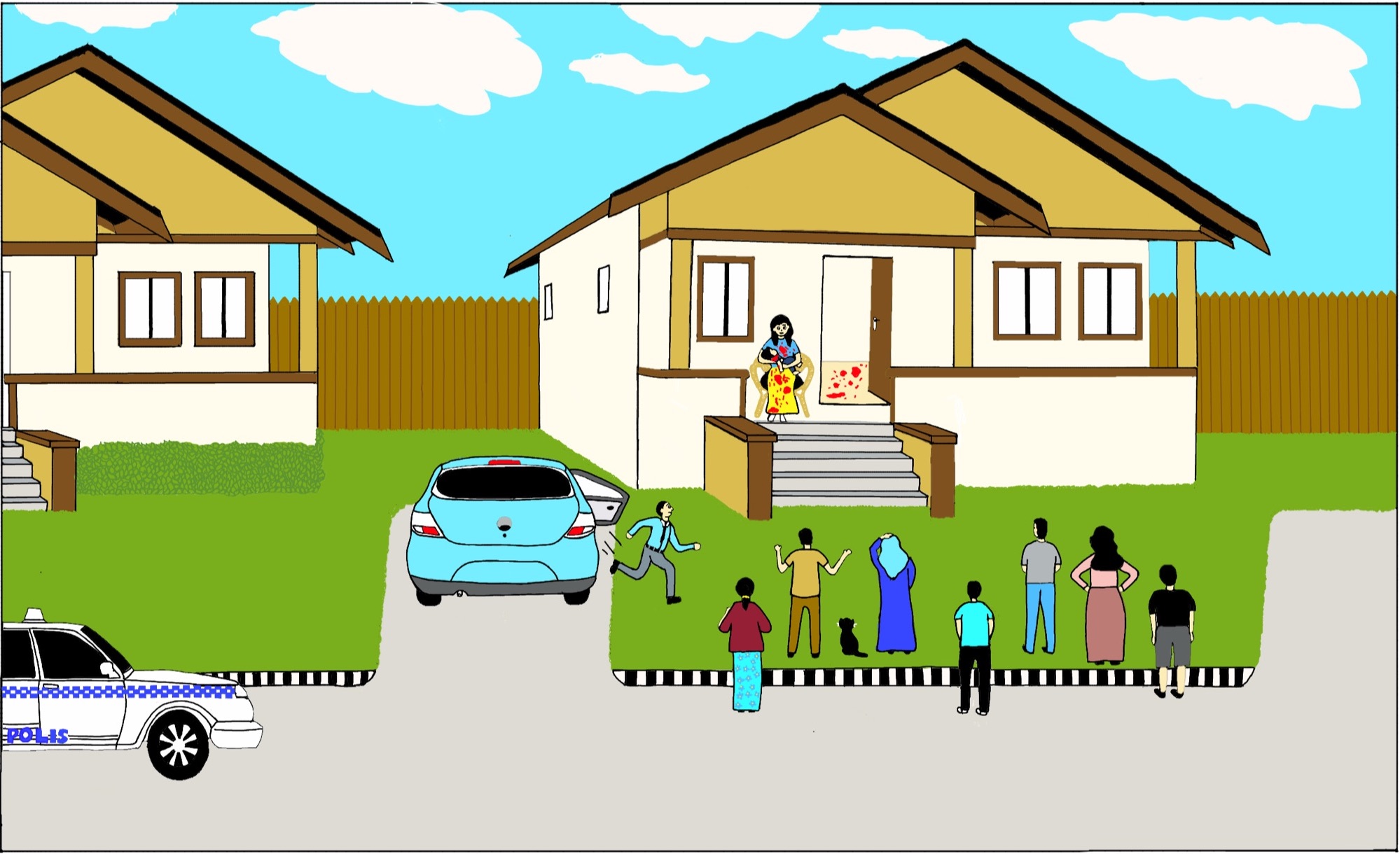
Daud immediately grabbed the toddler, and as soon as he did that, Shirley snapped out of her daze and started to scream hysterically. The police arrested Shirley. Daud rushed the toddler to the hospital where unfortunately the toddler was pronounced dead. 

Autopsy report showed that the toddler had seven cut wounds in the neck and four on the hands. Two deep wounds in the neck caused the death. The bloody butcher knife, Shirley’s and the toddler’s bloody clothes were all sent for forensic analysis, where it was determined that Shirley had indeed murdered the toddler. But, why did she do it? What was the motive? 

News about the horrific incident quickly spread to the country’s public, not as quick as today though. The words that went around were that this crazy amah sitting on the front steps nonchalantly sembalih a baby with a knife in clear sight for everyone to see. Although this version of event was not accurate, one thing the rumour got right, that the amah is indeed “crazy”. 

When asked why she did it, Shirley said that on that morning, she heard voices telling her to “do it”. When asked to do what, she answered “to kill the cat”. She took a knife from the kitchen and killed the “cat” by chopping it on the kitchen floor. The two mental experts who evaluated Shirley, including one flown in from Manila, said in their reports that Shirley has mental illness and was experiencing a psychotic episode the morning when she killed the toddler. 

The killing of an innocent baby by a psycho domestic helper shook the nation to the core. In particular, fear swept through families who have domestic helpers in their homes, questioning if their maids have undiagnosed mental illness and could have a psychotic episode anytime. It is not something that can be found in their resume when selecting one. Even the details in the resume are not necessarily all true. So, practically it is a gamble. When Zai learned about the murder, her face turned pale, her knees felt weak, she slumped down on the floor in shock, “that could’ve been my baby”, she thought in her mind. When news about it reached the Philippines, the lady whose child was once being nannied by Shirley also had the same emotional reaction – it could have been her child too. Looking back, it dawned on them that there were actually some peculiar things which they didn’t pick up as red flags, as they recalled catching Shirley talking, laughing and crying to herself.

While admitting to killing the “cat”, at her trial Shirley pleaded not guilty of murdering the toddler by reason of insanity (How to get away with murder 101). The two doctors who evaluated her vouched for her insanity stating that  “when she committed the crime she was mentally ill, psychotic, and not aware of what she was doing. She was suffering from psychosis of the schizophrenic type”.  Well, we all know where this is heading, as far as getting justice is concerned.

Dead Curious

This was on the 19 August 2021 BB. Anyone care to address the elephant in the room here? Do they expect people to just read this and move on to the next article without asking questions?

Before I get to the elephant, now let me first talk about this Mohammad Rafi fella. This guy has been in and out of jail for theft. By now, the authorities should get the message that repeatedly giving him “piecemeal” jail sentences for theft has no effect at all in stopping him from reoffending. Obviously this guy is either too lazy to earn a living or a hardcore kleptomaniac, in both cases he should be institutionalised permanently. On a bigger picture, criminals who were in and out of jail were not uncommon in Brunei especially thieves, with the record holder being sent to jail for more than 20 times!

Perhaps its due to the Covid-19 pandemonium that other major things that are going on get overlooked by the public’s attention. I mean theres a dead body of a woman in a car parked on the roadside at Jalan Mumong. Surely, that don’t happen everyday, but wheres the news coverage on that? Wheres the police press conference on it? How did she die? How did the dead body get there? Was she murdered? If she was, then shouldn’t the police at least appease the public by saying that they will investigate and catch the killer. Not divulging about the murder to the public wouldn’t help much in ensuring public safety when clearly there’s a murderer still at large (plus scores of other murderers of the many unsolved murders in the country).

Bow-some View

Rare chance to get to capture the complete semicircle of a rainbow in one frame not using a fancy photographer’s camera. So mesmerising. For a whole minute, I was fixated on the beautiful view, then the rainbow disappeared as the rain started.

Rainbow over Bandar and Kg Ayer, 25 Aug 2021 1819H

This will make an excellent postcard photo.

Travel Tales

Travel lovers are surely missing flying in this pandemic time. As for me, I don’t miss the flying part, but I do cherish all my past overseas trips, each with its own tales, funny first impression and culture shock moments. 

I was fortunate that my work gave me the opportunity to go to the UK a number of times. But my first trip to the UK, well..to any western country for that matter, took place when I was still studying. It was back in the 1990s, before there was mobile web, before there was google, before there was iPhone. Me and 4 others were selected as 5 top undergraduates in our batch and were rewarded to participate in the junior year abroad programme, an arrangement that our university had with a partner university in the UK. So off we went, 4 Brunei girls and 1 Brunei boy, all in our early 20s, all going to the UK for the first time. There are specifically 3 amusing moments that left me smiling every time I look back at that trip.   

1. Due-Vate

When we arrived at the UK University, fresh from the airport, we were taken to our accommodation, an 8-bedroom house on campus. We were asked to choose our respective rooms and to sign the inventory list verifying that all the items in the list are there in the room.

In my room, checking the inventory list, everything pretty much was there – bed, 2 pillows, bedsheet, night stand, dresser, mirror, clothing hangers. Then I saw “duvet” in the list. This may sound ridiculous now, but back then, I had not heard of this word and had no idea what it was. I didn’t have a mobile phone, let alone googling what duvet was. I went out of my room to check with the other Bruneians. They too were wondering what duvet was. There we were, supposedly the smartest in our uni batch, asking each other at the hallway “what is duvet?” We even pronounced the word wrong – due-vate. Well, that thing that we use to cover our body to keep warm while in bed, we grew up knowing it and still referring to it as a blanket. 

Duvet

2. You Jump, I Jump

The university is located at a beautiful city southeast of London. We spent the first few weeks there exploring the city’s historic buildings and amazing architecture. We very quickly learned about the short cut to walk to the city centre. Along the way, we also discovered that British pedestrians and cyclists say “cheers” every time we gave way to them, which we later caught on that that’s how they say thank you. The area at the city centre, where the shopping strips and other commercial activities are concentrated, they refer to as the high street. I remember the dismay look on our faces during the first time we went to the high street, when we watched the shops shutting their doors by 5pm. That was the first shopping culture shock that we encountered, because here in Brunei, shops are closed at 9-10pm. But this was in the 1990s. Today many shops in the UK do open until 9-10pm.

One pleasant shopping culture shock was the concept of shopping “outlets”. These are shops located at sites away from populated areas where goods especially name-brand products are sold at lower than their retail price. The nearest shopping outlet from us at that time was one 45-minutes away by train. Curious and with the shopping outlet experience in mind, one weekend we decided to take the train ride and go to the shopping outlet.

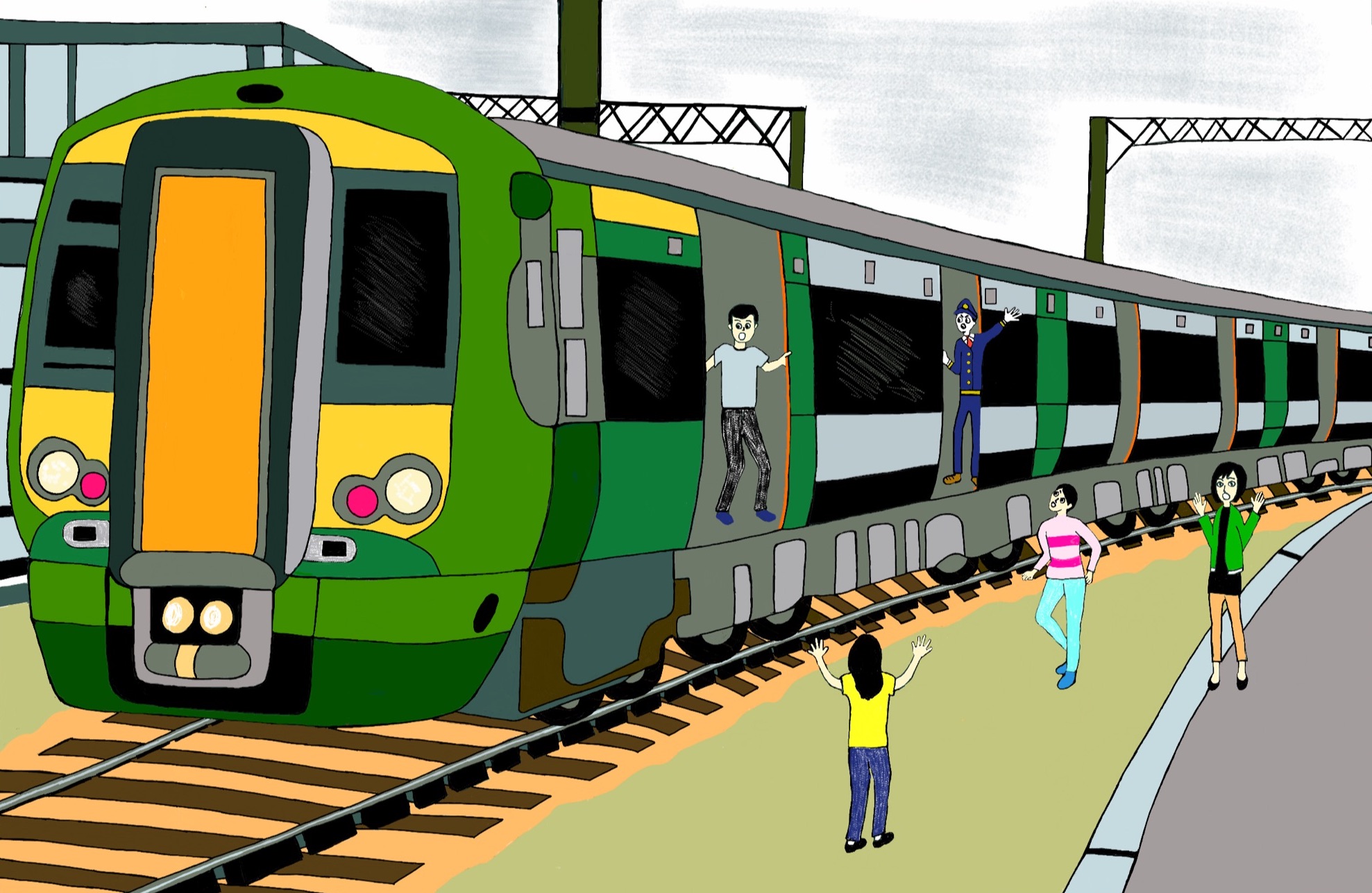
None of us then has ever taken a train ride before, except for the mini train at Jerudong Park Playground (does that count?). But, it can’t be that hard, we thought. There are two platforms, one for this way, one for the opposite way. In a true Murphy’s law moment, we went on to go to the wrong platform and boarded the wrong train. It was only when the train was about to move that one of us realised about the mistake, she said “wrong train!” sprung up and jumped out. Then like a chain reaction, each one of us started to jump out. The only boy in our group was the last one to react. By the time he wanted to jump, he hesitated a bit,  got spotted by the train conductor who shouted Oooi!!!. Looking back, we could just get off the next stop and board the right train instead of being drama queens about it.   

Train

Seriously, is Anyone Surprised?

So, the shit finally hit the fan. Anyone who didn’t see this coming must be living under a rock all this while.

Well, at least, now, I don’t have to see this headline again in BB – “Brunei records no new Covid-19 cases” stating no local transmissions have been recorded for certain certain hundred and so days. It was beyond deja vu, borderline annoying seeing this same headline every single day in the paper since last year. Flipping the pages of the newspaper, we also see every other day smuggling cases – alcohol and cigarettes especially. Where do all these contrabands come from? We could see people smoking in Brunei despite there being NOWHERE selling cigarette here. Where do the smokers get their supplies? Of course from across the border. Now, there was no point flaunting that zero case when there are holes in our so called “shield”. Was MOH aware about these holes? Was PMO aware about these holes? I don’t know. The wider public didn’t seem to be aware of it. They are content to hear that the border with Malaysia remains closed and that EVERY individual who enters our country through air and sea would undergo the full 2-week quarantine period. Did we use the “grace period” to cover these holes? I don’t know. But, it looked like more holes were poked instead, in the form of “special permits” and “essential travel” and allegedly complacency in the quarantine SOP.

25% Grades 75% Luck

Last Sunday, my secondary school alumni conducted a mini gathering at a fancy restaurant in Jerudong. I said mini because only less than half of the alumni attended, me being one of the non-attendees. I was free that day but I deliberately didn’t come simply because I wasn’t close with any of them during my secondary school years. As far as I could remember, a number of them were bullies, a number were the bullied ones, a number were snobs, a number were antisocial, a number were weirdos, a number no one even realised they existed, and now they are suddenly on a hugging basis, calling each other bebs, lings, bros. I was one of the antisocial ones back then and still is. Perhaps this is why I never get the alumni gathering concept.

Thanks to the mushrooming this and that alumni WhatsApp groups and of course the social media as a whole, people are able to know the updates (often too much information) on what each is up to even without being in contact or seeing them in person for years or decades even. It is rather striking that those who got the best grades, the top students in class, are not the ones who ended up getting the executive posts in the civil service. To put it simply, none of the smart kids in my schooling classes, even university batch made it above the Group posts. Whereas, those who were the low to average performing students, thrived more in the civil service, a number of them becoming Directors, Permanent Secretaries, even one of them became a Deputy Minister. Wow! I have my own theory as to why this is so. Some said they just got lucky, being at the right place at the right time. One thing for sure, grades got not much to do with one’s career path in the civil service. 

So, to students and parents out there, it doesn’t matter who got first in class, who got straight As, who got first class degree, as the success factors in the career stage of life would be 25% grades and 75% luck. Spare the stress.