One might say that Brunei is lucky in that its location spared it from major natural disasters like earthquakes or cyclones. I remember being in Quezon City in September 2011 for a meeting right about the time when the powerful typhoon Nesat hit the Philippines. There was a day where we were not allowed to leave the hotel, the hotel’s glass doors and windows were shaking and rattling. Outside we could see branches, leaves and litters flying around. The creepy, eerie sounds of the strong wind sent shivers down my spine. The strength of the wind was nothing that I and perhaps any other Bruneians have ever seen before, and that was just the tail wind of the typhoon. So yeah, we were lucky, but that is no reason to be complacent.
It has been 11 years, but the memories of the chaos in 2009 were still fresh in the minds of Bruneians who lived through it.
In January 2009, continuous rain battered the country causing flash floods in many areas with water reaching up to 5 feet high. Blocked drains further caused water levels to rise quickly. In rural areas like Kg Sukang, the water level even rose up to 4 meters high. Of course, Brunei had experienced flash floods before that, but the rainfall intensity that January 2009 were more than normal.
Some schools had to be closed as the classrooms were flooded with water. Homes and business establishments were inundated with flood waters. Many roads were flooded and rendered impassable.
The continuous downpour which started on 09 January 2009 had also caused many landslides forcing affected residents to vacate their homes. Several hilltop houses were in danger of being swept downhill by landslides as retaining walls were on the verge of collapsing.
The FRD hotline was off the hook with emergency calls. Towing services were overwhelmed with calls to assist flood hit vehicles.
By 19 January 2009, all hands were on deck. The military with their large trucks, the FRD covered hills with canvases, shelters and packed meals were provided to flood victims whose homes were badly affected, police erected warning signs and blocked flooded roads from traffic.
But nature was not done yet, unleashing its ultimate wrath on 20 January 2009 with the heaviest rainfall battering the country, that would trigger a chain of events, events that the public and private entities perhaps never even factored in their scenarios planning and business continuity plans. The chaos that ensued showed how ill-prepared we were. It was a rude awakening, a manifestation of our complacency, dragging our feet on building disaster preparedness and resiliency.
20 January 2009 was a Tuesday. It had been raining since 0800+pm. That evening I was at my sister’s house in Kg Tungku, waiting for the heavy rain to stop so that I could go back to my place. By 1000pm the rain kept on pouring and didn’t show any signs of slowing down, so I said the heck with it and decided to brave the downpour and drive home. It was supposed to be just a 12 minutes drive. Back then there was no WhatsApp or Instagram yet, so no “live reporting” on what were going on out there.
First I encountered a flooded road, totally expected. Eventhough the road was totally submerged, the drainage railings could still be seen and this helped a lot in keeping the car on the invisible road. The likelihood that my car would stall while driving through the flood did cross my mind but the cars in front me got through just fine, so I took a chance. I was driving really slowly and everything was fine until some psycho in an SUV from the opposite lane ploughed through so fast like it was no one’s business. Right then my car was dead. Just great! I switched on my hazard light, waited for a few minutes before restarting the car again. Oh! What a relief, the car came back to life.
As I drove on, with the rain still pouring, I saw that the first traffic light that I encountered was dead. I began to notice that the surrounding buildings were all dark. The power was down. Talk about bad timing. Little did I know at that time that that was the beginning of the Brunei’s great blackout.
The heavy rain that day had caused the 66,000-volt main power station in Gadong to be submerged in 3 feet of water, tripping the turbine generator. Power was interrupted at 1100pm causing blackouts in a number of areas in Muara and Gadong as well as BSB. Shops at commercial areas of Gadong including the Mall, Batu Besurat, Kiulap were not spared. Traffic lights in the affected areas also lost power.
Driving in the heavy rain, in the dark, maneuvering every intersection, never had I ever wanted to get home so badly. Then, from afar, I saw it. No, it can’t be! I said to myself. I saw the Kiarong underpass, our country’s famed one and only “tunnel” was almost completely filled with water. How was that even possible.
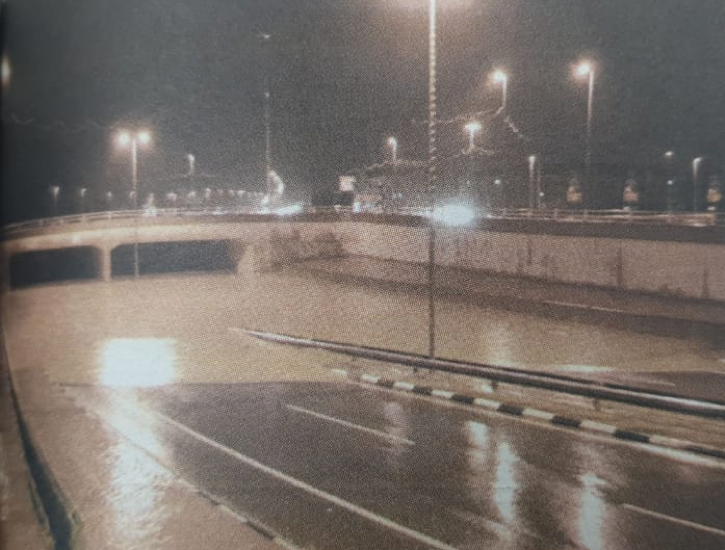
Source: Borneo Bulletin, Jan 2009
The underpass is actually equipped with 8 water pumps to drain out excess water completely. It also has a backup generator which automatically switches on in case of power failure. Then what happened? It was later explained that as a safety precaution, the pumps had to be switched off that night because of the overwhelming water flow which was fast submerging not only the water pumps but also the back up power system which could’ve done further damage to the generator. The tunnel was closed off and would only be reopened in the morning of 22 January 2009.
It had already been 30 minutes of my supposedly 12 minutes drive home that night. After the horror look on my face stood down, I drove around the flooded tunnel, took the roundabout and continued on my journey home. I looked at my watch, it was already past 11pm. As I reached the final stretch of road to my place, I saw our building, it was completely dark, then it dawned on me that the elevators would not be working and I would have to take the stairs. Oh crap! Let’s just say that my unit is at a double digit floor of the building and the stairwell was narrow and completely dark.
Finally I reached my place but instead of feeling relieved, I felt a sense of dread. It was close to midnight. Our building is notorious for being haunted. But, that was the least of my worries. The thing was that other than ghosts, criminals also took a liking to our building, breaking into a number of units. So, I was more concerned about some criminals lurking in the dark stairwell. The story about how I got out of this sticky situation was epic, but that would be covered in another post.
Back to the black out, despite the best efforts of the Department of Electrical Services, normal power supplies would only be restored after four days of mass blackouts. The prolonged power outages had led supermarkets and kedai runcits alike to suffer a lot of losses as frozen food and raw meats went bad, ice creams melted, among other predicaments.
On top of the mass black outs, telephone lines were also down as the flooding had also damaged telbru’s telephone equipment in Gadong. Yep, including the police hotline too. Due to the power supply disruption, some areas suffered lack of DST network affecting mobile phone services.
It is not an overstatement to say that our first responders were running around like headless chicken especially on the night of 20 January 2009. The FRD had to scramble its manpower to respond to the hundreds of distress calls – flooded homes, falling trees, falling lamp posts, landslides, the works. Police personnel were deployed to control traffic at flooded roads and at intersections with dead traffic lights. The military with their big trucks to assist stranded villagers, using boats at areas even their trucks couldn’t get through. In the midst of the pandemonium, sadly however, they couldn’t get on time to save two people who lost their lives that fateful evening.
At around 1045pm, residents of a house in Jalan Pasir, Berakas heard a loud bang. A landslide had crashed into the back of the house, caving in the walls of the kitchen and several rooms of the house. All managed to flee except one, a 46 year old woman who was fast asleep at the time of the incident. The wall of her room collapsed on her trapping her under the debris of mud and concrete. Attempts to immediately pull her out were unsuccessful and she was killed.
The other heartbreaking loss of life happened at the very stretch of road where my car stalled that night. The incident happened after midnight. A man had just fetched his 19-year old daughter from work and was on the way back to their house in Kg Katok. By the time they reached within a kilometer from their home, the road had already become too flooded and could no longer be driven through. The father and daughter decided to leave the car and get home by foot. While walking through the rapid flowing water, the daughter unfortunately slipped and got sucked into the storm drain. Trapped by the drainage railing, efforts by her father and two other men to lift and pull her out failed and she drowned.
Heavy rains continued to batter the country throughout January and into February before slowing down towards March that year. Hundreds of houses had suffered damages. Some water pipes, roads and sewage systems in a number of places also suffered damages. A concrete bridge at Jalan Kg Tunggulian in Sg Liang even collapsed as a result of the flooding. The heavy rains also led to nearly a million dollars in damages to crops and livestock throughout the country as farms and paddy fields were submerged in water and thousands of chicks perished.


 OBMM's Blog